ArchMind

Doc Analyser · A product by Kalajna Labs

Does the code do what the documents say?

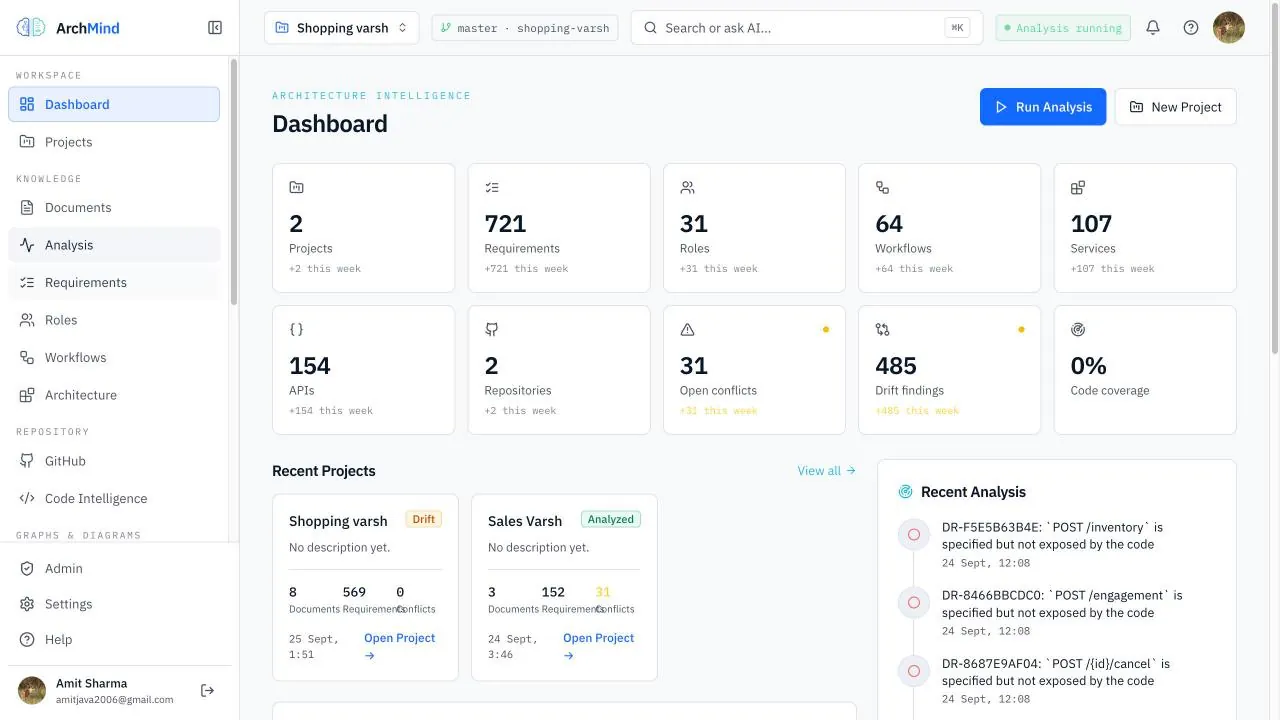
ArchMind reads your RFP, BRD, HLD, LLD, API and DB designs and the GitHub repositories that implement them. It turns both into one evidence-backed knowledge model, then generates traceability, conflict reports and architecture diagrams from it. Everything runs on your own hardware.

100% local inference Ollama + pgvector Mermaid · PlantUML · Graphviz Page-level evidence
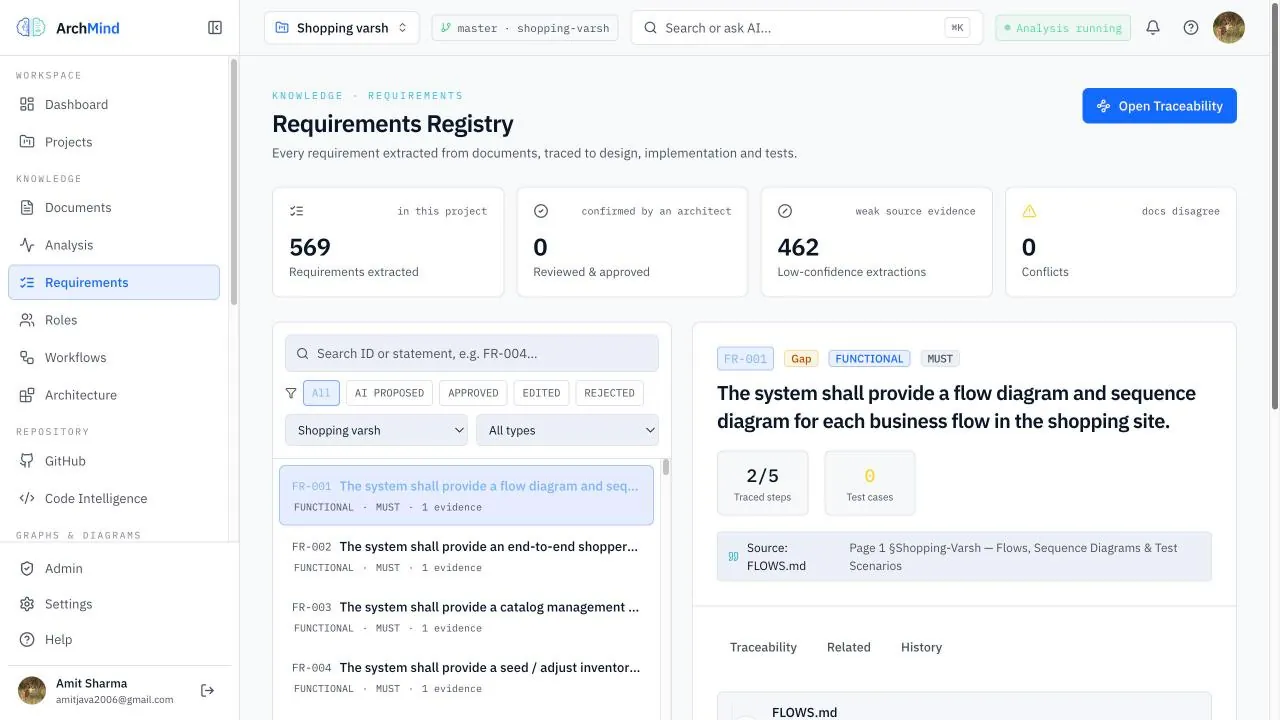
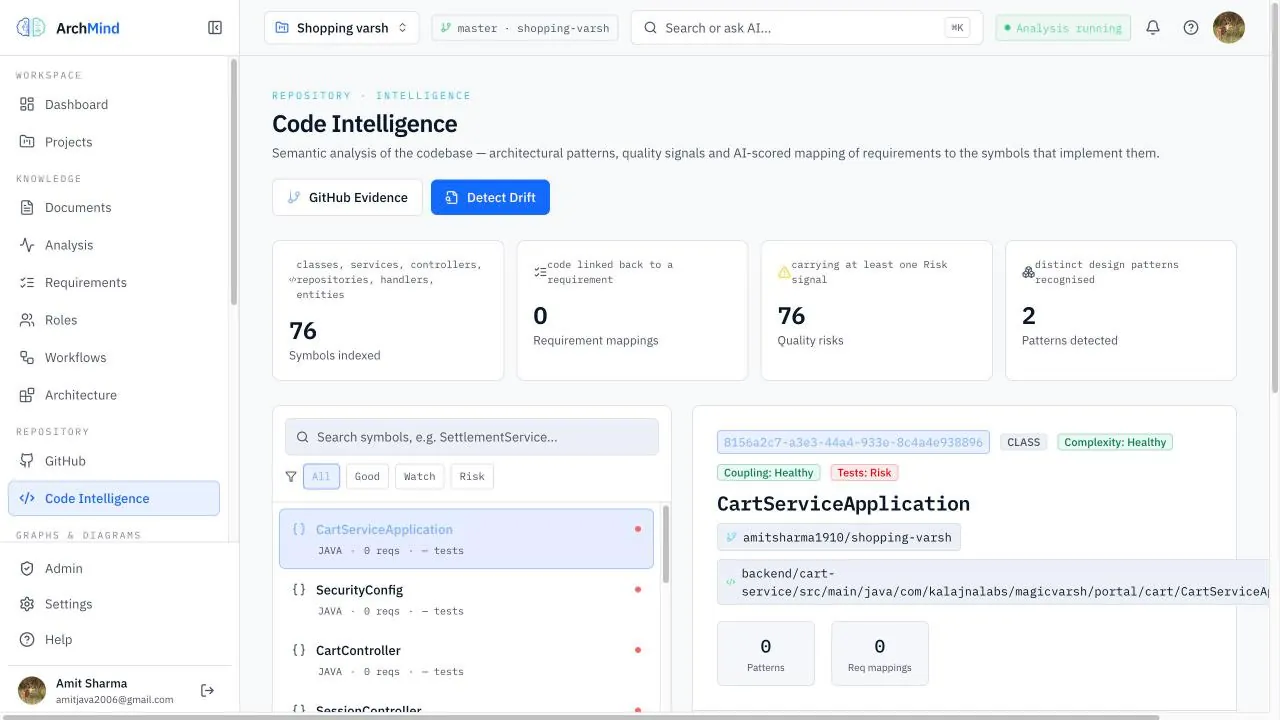
ArchMind architecture intelligence dashboard ArchMind requirements registry ArchMind diagram gallery ArchMind mind graph of a drift finding ArchMind code intelligence
0
Analysis agents
0
Diagram types
0
Languages parsed
0
External AI calls
Why ArchMind

Design documents and code drift apart. ArchMind shows you where.

On any large project, the RFP says one thing, the HLD another, and the code a third. Reviews end up as people reading 200 pages next to a repository. ArchMind does that reading for you. It extracts every requirement, role, workflow, service, API, table and event, links each one to the page it came from and the class or method that implements it, and reports what is documented but not built, or built but never specified.

Core principle: the language model interprets the documents; deterministic software owns the knowledge model, validation, traceability and diagrams.

How it works

From a folder of documents to a verified model

Five stages, each persisted server-side. You can close the tab mid-analysis and come back later.

Ingest

PDF, DOCX, PPTX, XLSX and Markdown are parsed with page mapping and local OCR, then classified, split into sections and chunked with tables kept intact.

Deterministic

Interpret

Seven local-model agents extract requirements, roles, workflows, services, APIs, tables, events and classes as schema-constrained JSON. Each item carries a quote and a page number.

Local LLM

Validate

A cross-document validator compares RFP ↔ HLD ↔ LLD. Each item gets a confidence level, and an architect can approve, edit or reject it.

LLM + rules

Trace & draw

The traceability matrix and every diagram are pure functions of the validated model. Same model in, same output out.

No LLM

Compare with code

Linked repositories are parsed into a symbol graph, matched to the model, and checked for drift after every push.

No LLM
Capabilities

Everything an architecture review needs

📋

Requirement extraction

Atomic, typed requirements (FR-001…) with actor, priority, pre/post-conditions and source page, in one searchable registry.
👥

Role intelligence

A deduplicated role catalog with aliases, responsibilities and UPPER_SNAKE_CASE permissions, ready for your RBAC design.

🔀

Workflow intelligence

Ordered steps, actors, decision branches, states and exception paths for every process the documents describe.

🧭

End-to-end traceability

Requirement → Role → Workflow → Service → API → Data → Class → Method, exportable as a CSV matrix.

⚠️

Conflicts & gaps

Role mismatches, contradictions between documents, unimplemented requirements, untraced design and missing NFRs.

💬

Ask the documents

Grounded Q&A over hybrid vector, full-text and knowledge-graph retrieval. Every answer cites the document, page and section.

🧬

Code intelligence

Java/Spring, Python, TypeScript/JavaScript, C#/.NET and PHP parsed into packages, classes, methods, REST endpoints, ORM entities and events.

🔎

Evidence & confidence

Every object shows its quote and a confidence level based on evidence strength, cross-document agreement and rule checks.

🔐

Multi-user workspaces

GitHub, Google or email sign-in, per-project membership and four roles: Admin, Architect, Analyst and Viewer.

Diagrams

How ArchMind prepares its diagrams

ArchMind never asks a model to “draw a diagram”. Diagrams come from the validated knowledge model, so each box and arrow traces back to a line in your documents or your code.

1
ExtractAgents pull workflows, services, APIs, tables, events and classes out of the documents, each with its evidence.
2
ValidateCross-document checks and architect review decide what goes into the model.
3
GenerateA deterministic generator turns the model into Mermaid, PlantUML and Graphviz source. Re-running it on the same model gives the same diagram.
4
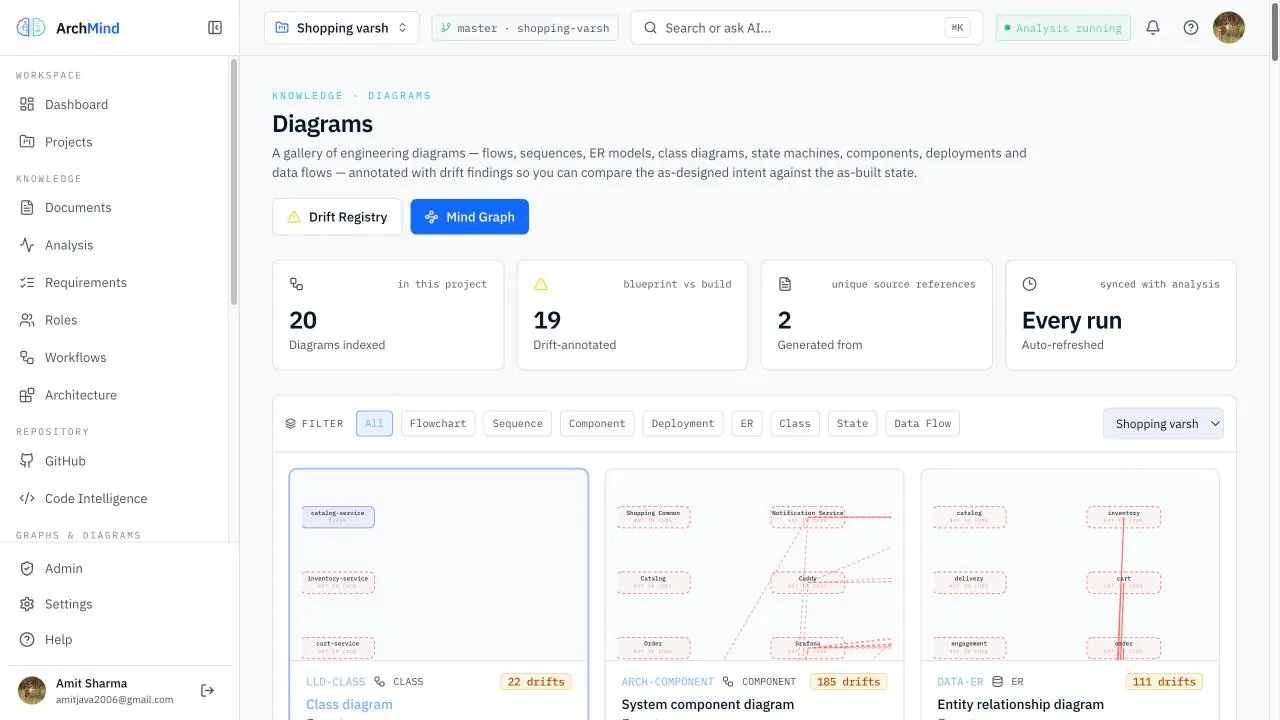
AnnotateAfter each analysis, drift findings are overlaid on the diagrams. Parts that are designed but not built show up red and dashed.
ArchMind diagram gallery with drift annotations

Every diagram, and what it's for

Twelve views of the same model, each for a different conversation. Red dashed elements show drift ArchMind has found between design and code.

Start Submit OK? yes no Approve Rework
Process

Process flowchart Mermaid

How it's built
One per workflow the Workflow Analyzer finds. Ordered steps become boxes, decision points become diamonds with their yes/no branches, and exception paths loop back. The document's trigger and outcome become Start and End.
What it's for
Walk a business process with stakeholders, and spot branches the documents never finish describing — an approval with no rejection path, a step with no owner.
ApplicantReviewerAdmin Apply Review Publish Notified
Process

Role workflow Mermaid

How it's built
For each role in the catalog, ArchMind collects every workflow where that role is the primary actor or performs a step, and lays them out as that persona's journey from login to done.
What it's for
Write UAT scripts per persona, onboard new users, and run access reviews — you see exactly what each role is expected to do.
User Order API DB POST /orders persist id 201 Created
Behaviour

Sequence diagram Mermaid · PlantUML

How it's built
Built from each workflow's steps: actors call services, services persist to their tables, and published events appear as async messages — in the order the documents give.
What it's for
Agree API contracts, see sync vs. async hops, and debug integration order before anyone writes code.
Draft Review Approved Rejected changes
Behaviour

State machine Mermaid · PlantUML

How it's built
Uses the states and transitions the design declares. When a document only implies them, they are inferred from each step's “state after”. Approved, Rejected, Closed and Completed are marked as final states.
What it's for
Validate lifecycle rules, find dead-end or unreachable states, and drive the status enum and its tests.
Web UI Gateway Orders Catalog DB Payments
Structure

Component diagram Mermaid · PlantUML

How it's built
Every service, UI, gateway and external system in the architecture model, plus the tables they persist to and the topics they publish and subscribe to. Parts the code doesn't implement are drawn red and dashed.
What it's for
A one-page system overview for architecture reviews and new joiners — with the unbuilt parts impossible to miss.
web app auth user mail
Structure

Service dependency graph Graphviz

How it's built
The service-level slice of the architecture graph: who depends on whom, rendered as a directed graph.
What it's for
Estimate blast radius before a change, order deployments, and catch dependency cycles.
Order - id: UUID- status: Status- total: Money + submit()+ cancel() OrderLine - sku: String- qty: int 1..*
Design

Class diagram Mermaid · PlantUML

How it's built
Classes, attributes, methods and relationships extracted from the low-level design, with composition and inheritance parsed from the text.
What it's for
Review the domain model with developers and compare it with the classes that were actually written.
customer PK idnameemail orders PK idFK customer_idplaced_at
Data

ER diagram Mermaid

How it's built
Tables, columns, primary and foreign keys, and cardinalities taken from the database design documents.
What it's for
Review schemas, plan migrations, and settle which service owns which data.
Orders order.placed Inventory Loyalty ✕
Integration

Event flow Mermaid

How it's built
Domain events linked to their producers and consumers across services. A topic with nobody subscribing — or a subscriber the code never wires — is flagged.
What it's for
Audit async coupling and find orphan events before they turn into silent data loss.
com.shop cartCartController orderOrderService GET /cart/{id} POST /cart/items POST /orders POST /refunds
From code

Code maps Mermaid

How it's built
Packages, classes, REST endpoints and ORM entities parsed straight from the repositories (Java/Spring, Python, TypeScript/JavaScript, C#/.NET, PHP) using imports, annotations and declarations. No model guesses these edges.
What it's for
See what was actually built: the API surface, package layout and repository mind map, set side by side with the design.
DR-91drift FR-043 FR-12 FR-246 HLD §4 Cart.java commit a1f
Traceability

Mind graph & traceability Interactive

How it's built
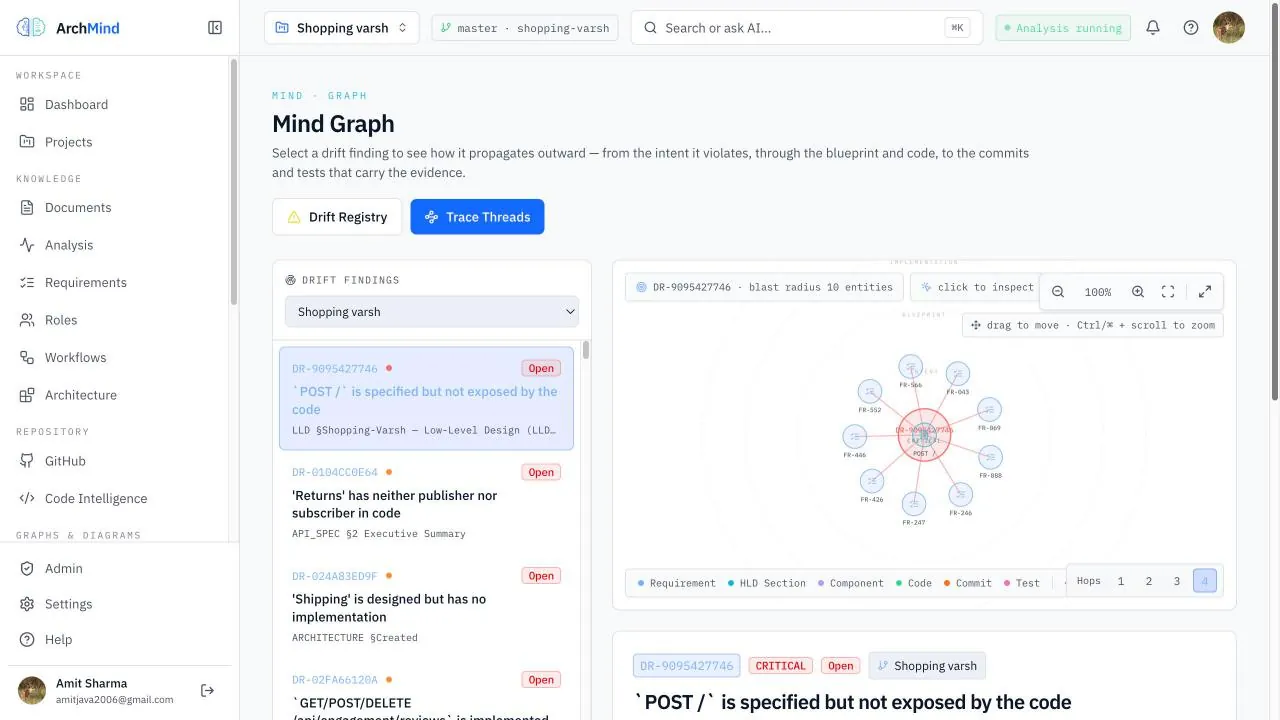
Starts from a requirement or a drift finding and follows the links outward: requirement → role → workflow → service → API → class → method → commit.
What it's for
Impact analysis and audits: ask what breaks if this changes, and which requirements a finding puts at risk.
Knowledge model Mermaid PlantUML Graphviz CSV matrix
Output

Export anywhere DSL · CSV

How it's built
Each diagram is stored as its source DSL, not a picture — Mermaid, PlantUML or Graphviz. The traceability matrix exports as CSV.
What it's for
Paste diagrams into Confluence, GitHub, Markdown docs or your own tooling, and keep them under version control.
ArchMind mind graph tracing a drift finding
Architecture drift

Know the moment design and code diverge

Drift detection compares the knowledge model with the code model on exact keys: route, table name, topic. No model is involved, so a finding is something you can verify. Each finding keeps a stable ID across runs, and one that stops happening is marked resolved rather than deleted, which leaves an audit trail.

API_NOT_IMPLEMENTED API_METHOD_MISMATCH SERVICE_NOT_IMPLEMENTED UNDOCUMENTED_ENDPOINT UNDOCUMENTED_COMPONENT UNDOCUMENTED_TABLE ENTITY_NOT_PERSISTED EVENT_NOT_WIRED UNDECLARED_TOPIC

Severity is raised automatically when a finding affects must-have requirements.

Private by design

Your documents and code never leave your servers

RFPs and source code are often client-confidential, which is why ArchMind does all inference locally. It calls no hosted AI service at runtime.

✓
Local models via OllamaReasoning, extraction, vision and embeddings are routed by capability. Swapping a model is a config change.
✓
Strict project isolationEvery retrieval is scoped to one project. A non-member gets a 404, so they can't even tell another project exists.
✓
Read-only GitHub accessThe GitHub App requests only Contents and Metadata, and ArchMind never writes to your repositories.
ArchMind
Knowledge · Architecture · Code

The blue half of the mark is the design; the teal half is the code. ArchMind is the line joining them.

Open the live demo ↗
Under the hood

Built on a proven stack

Backend

Python, FastAPI modular monolith, background analysis runner

Frontend

React 19, TypeScript, Tailwind 4, shadcn/ui

AI (local)

Ollama: Llama 3.1, Mistral, Llama 3.2 Vision, nomic-embed

Retrieval

PostgreSQL + pgvector, full-text search, knowledge graph, RRF fusion

Storage & queue

MinIO for documents, Redis

Integrations

GitHub App with webhooks, Keycloak SSO, Mermaid / PlantUML / Graphviz

See ArchMind on your own project

Try the live demo, or talk to us about running ArchMind on your documents and repositories inside your own network.